
Randolph County Court Record Requests
Gather the basics before you ask for anything. A Randolph County court record request works best when you know the case number, the court, and the document or docket you want. Decide on a plain copy or a certified one. Search the North Carolina eCourts Portal by case number or name first. The Randolph County Case Summary will supply the exact number, the court, and the event date. Your clerk request needs that public document title too.
From there, a requester has several channels. The Portal shows public Case Summaries and any public images. The Clerk office offers a public terminal, paper-file review, copies, and certifications. Call the Clerk to confirm the charge, delivery method, and current processing estimate. The county posts no dedicated mail, fax, or email court-copy form. It promises no turnaround time either, so assume neither. The official court-records instructions walk through the clerk terminal, paper files, copies, audio, and transcripts in detail.
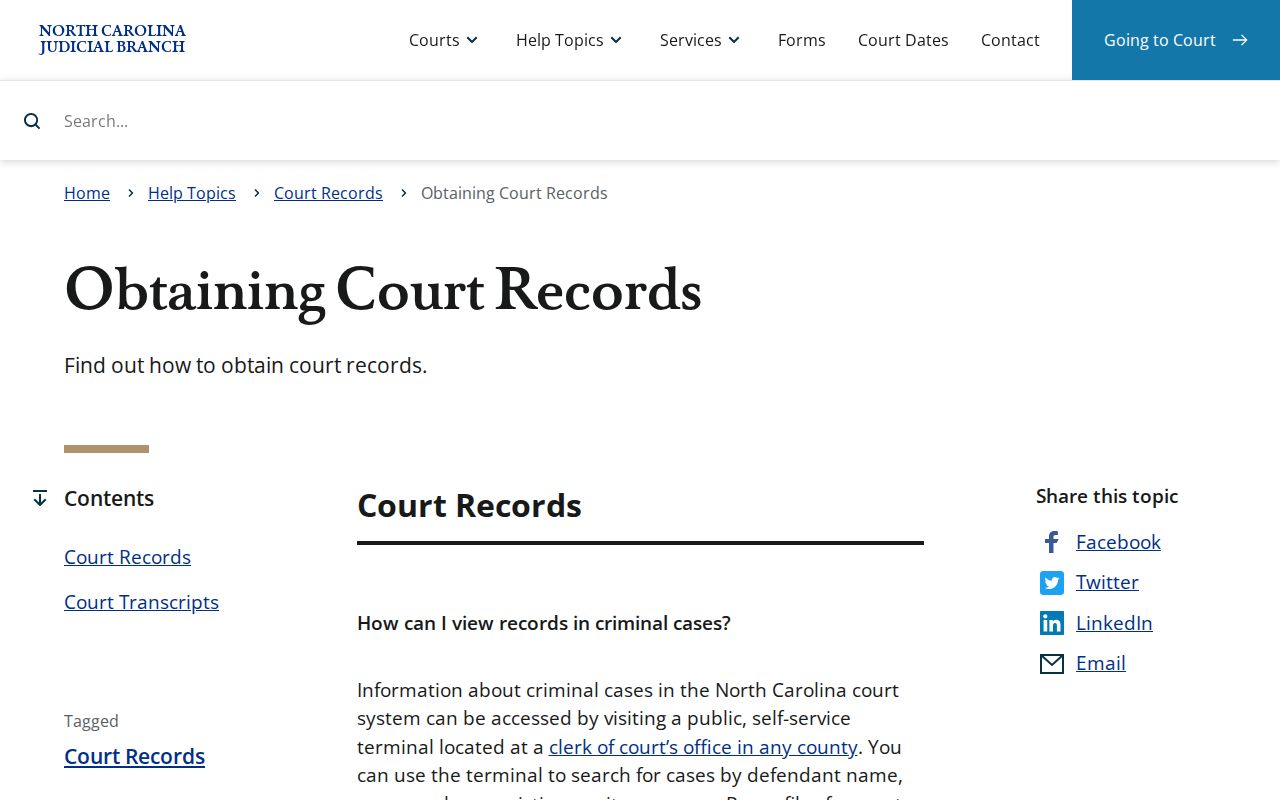
In Randolph County, the working sequence is a Portal docket search, then clerk review, then the copy request.
- Find the Randolph County case number and court in Portal or on the filing.
- Name the Randolph County docket, document, date range, or record type wanted.
- Choose Portal, clerk terminal, paper file, phone inquiry, or clerk request as the appropriate channel.
- Ask whether a plain or certified Randolph County copy is needed and request the current total.
- Verify the Randolph County record with the clerk before relying on an official-use copy.
Randolph Court Record Search Channels
Randolph County runs one unified Clerk structure for Superior Court, District Court, magistrate, estates, special proceedings, and related trial-court files. Online Smart Search is the public reading route. At the courthouse, clerk-office terminals and paper files back up anything the screen lacks. The Clerk answers the phone at 336-328-3100. Separate Superior and District Court offices handle setting questions.
The records hub sits at the courthouse, 176 East Salisbury Street, Suite 201, Asheboro. Clerk hours run weekdays from 8:30 a.m. to 5 p.m. Leave the phone and camera at home. The county bans cell phones, computers, multimedia devices, and cameras inside the building. You cannot photograph a terminal screen. The clerk office, not a general county department, holds the court files.
Randolph County Clerk of Superior Court
176 E. Salisbury St., Suite 201
Asheboro, NC 27203
336-328-3100
Kinds of Court Records
A Randolph County court file can include several distinct things. There is the Case Summary or Register of Actions, the public filed documents, certified copies, transcripts, and recordings where those exist. The type you want decides the channel. Portal displays a searchable case summary plus any public image. The Clerk holds the file and certifies documents. A court reporter or approved transcriptionist handles transcripts. Nonconfidential recorded-hearing material may follow a separate clerk process.
One caution is worth repeating. A Case Summary is not the whole file, and a filed order, judgment, pleading, or exhibit may be public, restricted, or missing from the online view. The Clerk can point you to the right file path, but access still turns on the record's status and the confidentiality rules that apply.
- Randolph County Case Summary or Register of Actions for dated case events.
- Randolph County public pleadings, orders, judgments, and other filed images when Portal provides them.
- Randolph County certified copies authenticated by the Clerk of Superior Court.
- Randolph County transcript inquiries through the court reporter or approved transcriptionist.
- Randolph County digital-audio requests for nonconfidential matters where a recording exists.
Randolph Case Summary and Filed Images
Three terms get mixed up constantly in a Randolph County case. The Case Summary is the Portal's chronological map of parties, events, hearings, disposition, and finances. A filed image is an actual pleading, order, judgment, or exhibit. It appears only when it is public. A certified copy is a Clerk-authenticated copy for official use. Portal itself says plainly that it is not the official court record.
Read the Case Summary first. Then open any public image offered. Public summaries and images usually show up within minutes of upload, subject to processing. Downloads come one document at a time. Anything confidential, sealed, sensitive, or oversized may never reach the public view. Then ask the Randolph County Clerk a simple question. Does a public paper file exist, or can a proper copy be made?
| Randolph County record | Channel | Use |
|---|---|---|
| Case Summary | Portal, clerk terminal, clerk file | Public chronology and core case data. |
| Public filed document | Portal when public; otherwise Clerk file | Pleading, order, judgment, or other image. |
| Certified copy | Randolph County Clerk | Clerk-authenticated official copy. |
Court Records: What They Contain
What sits inside a Randolph County court record varies with the case. Expect basic case information, assignment data, and parties. Dated Case Events, hearings, dispositions, and causes of action for relevant civil and family matters may follow. Financial information appears where it applies. A criminal Portal search is party-based, while civil and probate matters can carry Causes of Action. Public users get no Social Security number validation. Any date of birth shows only the year.
The case number itself follows the Enterprise Justice pattern: year, case-type letters, a six-digit sequence, and a county identifier. Type it exactly as printed. Do not guess at a local case number format. The Case Information and Assignment Information blocks show the real thing. Read those blocks before drawing conclusions from an event label.
| Case and assignment | Randolph County case number, description, status, and court assignment. |
|---|---|
| Parties | Participants and roles; public personal data can be masked. |
| Causes of Action | Claim category for relevant civil, family, probate, or mental-health cases. |
| Case Events and Hearings | Dated docket actions and settings; Search Hearings is the current-calendar route. |
| Disposition and financial data | Outcome and applicable costs, fines, restitution, or balances. |
Randolph Clerk Holds Court Files
Ask the wrong office and your Randolph County court file request goes nowhere. The Randolph County Clerk holds the case file itself, not the NCAOC administrative-records office. That distinction trips up plenty of requesters. The statewide Judicial Branch public-record request form covers only administrative agency records that already exist. Its own instructions are blunt. Copies of court files and case information must come from the clerk in the county where the case was filed. The NCAOC public-record request source spells out that administrative channel. Its limits for court files appear there too.
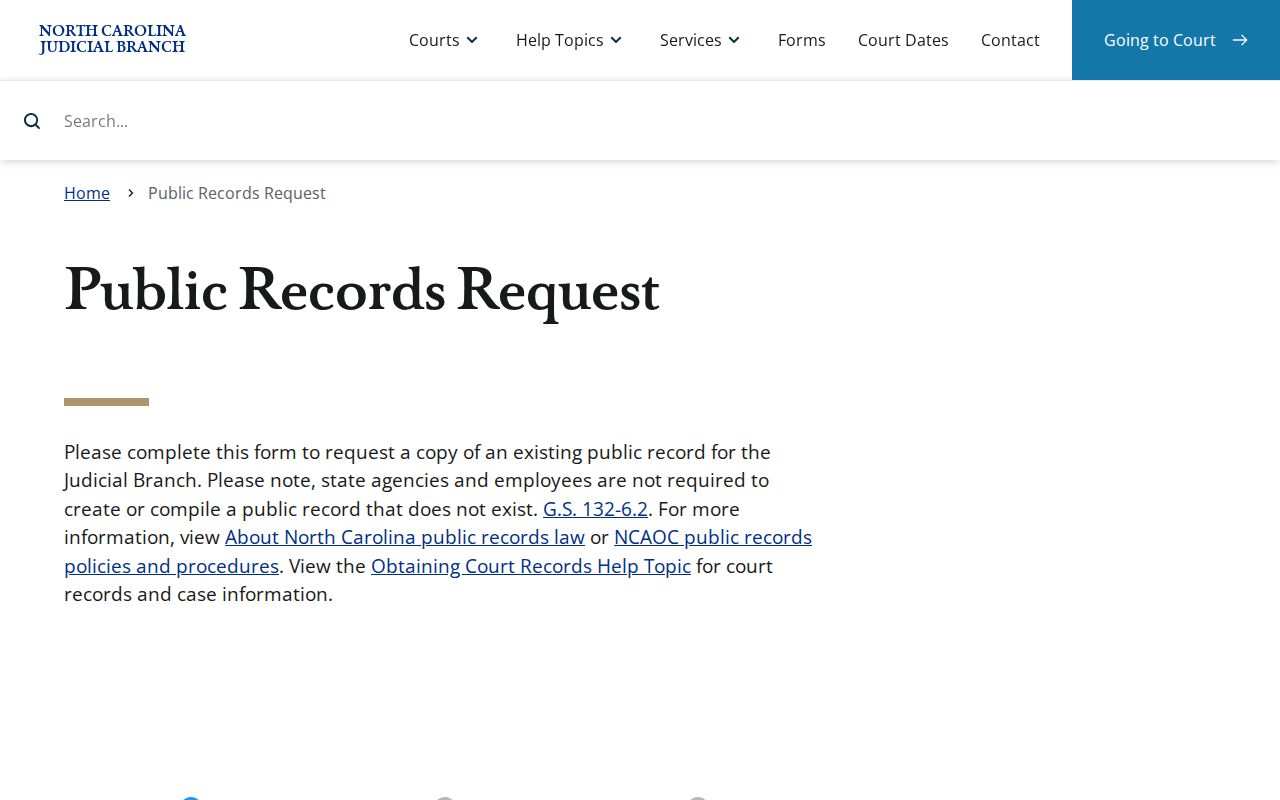
That same statewide forms resource points the requester back to the local office: a Randolph County court-file copy comes from the Clerk, not from a state portal. The NCAOC public-record policies source backs this up, naming the Clerk as the proper office and setting out how a response should work.
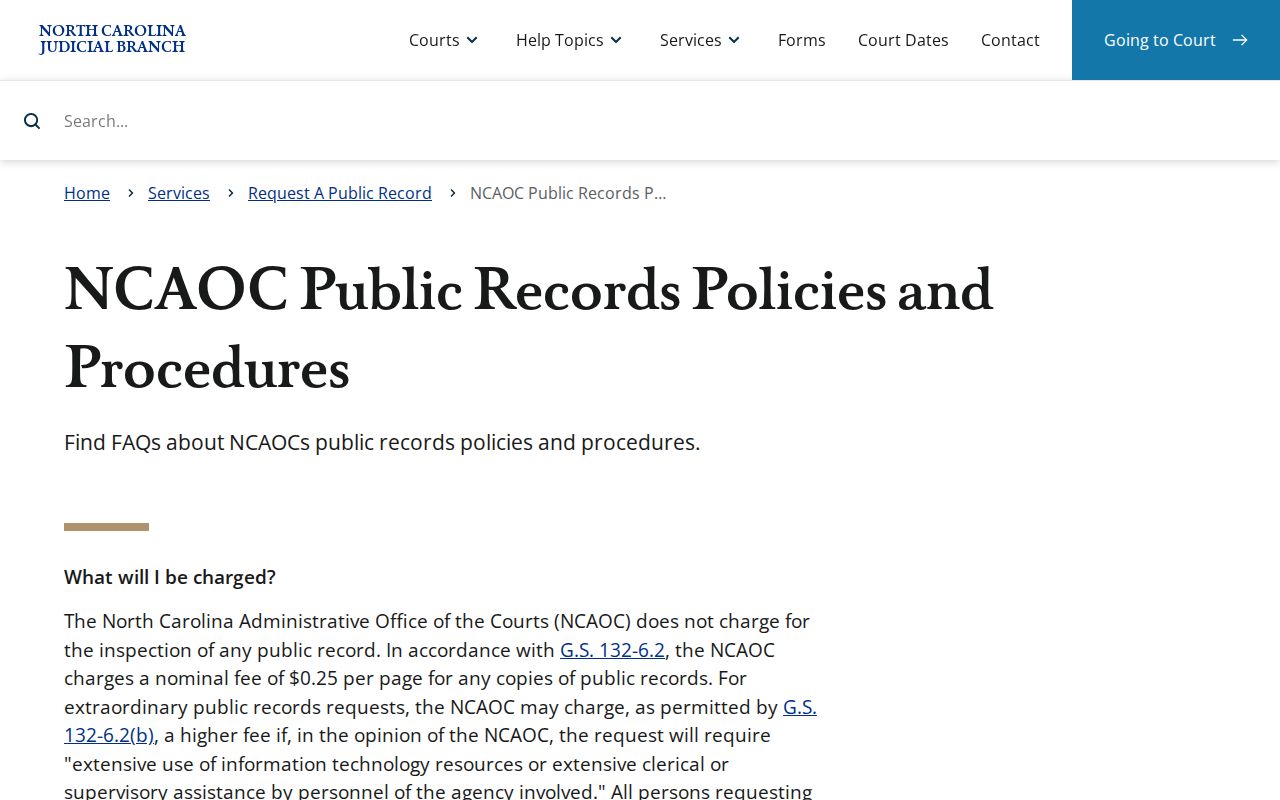
The policy page still does not hand the Clerk's job to anyone else; only the Randolph County Clerk can issue that copy or its certification.
Copy Fees and Certification
Randolph County copy costs break into three parts. Think preparation, certification, and any search you ask for. The January 2026 Miscellaneous Court Costs chart puts preparation at $2 for the first page of a document. Each additional page or fraction adds $0.25. A certificate under seal runs $3, an exemplification $10, and a criminal-record search $25. So a $3 seal alone is not the whole price of a certified Randolph County copy. Preparation and certification can stack on top of it. The official court-costs explanation gives the statewide fee context behind these figures.
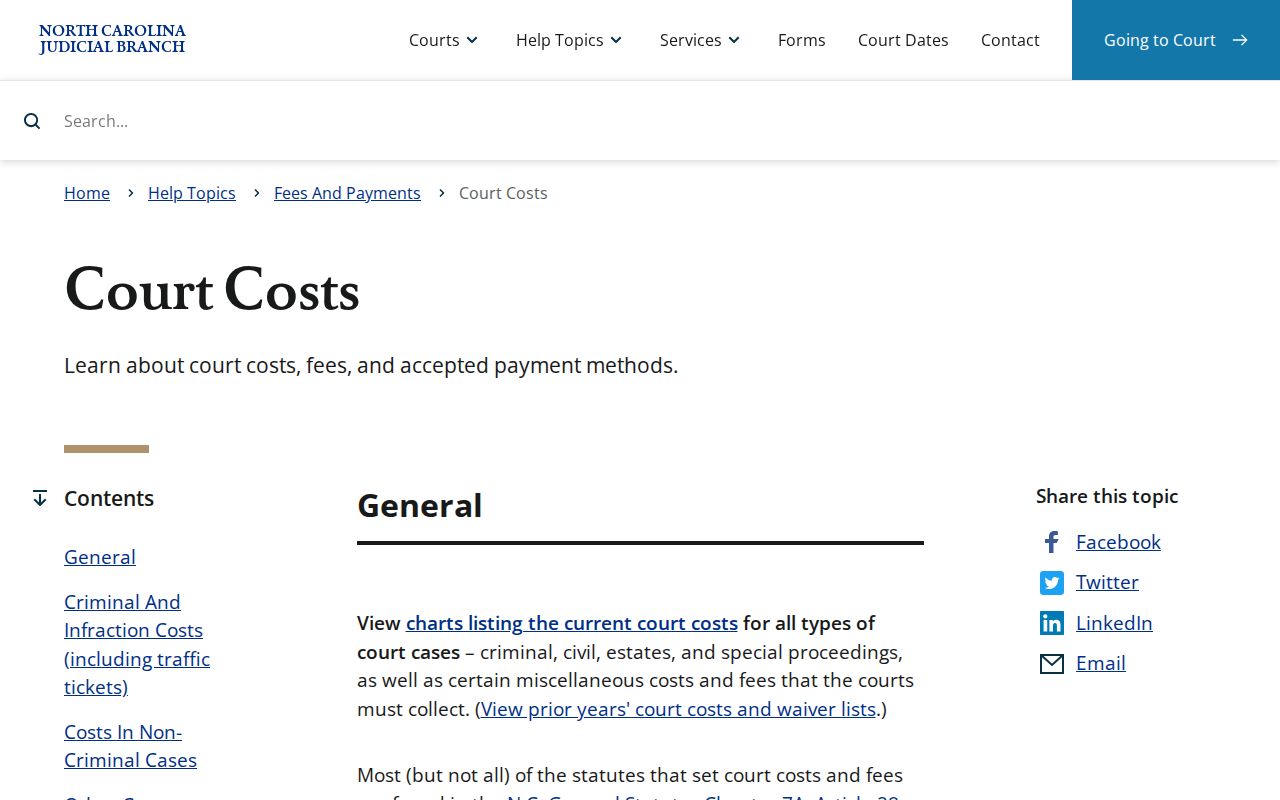
This is why a Randolph County requester should pin down the record type before paying anything. The official current court-costs index holds the chart those amounts come from.
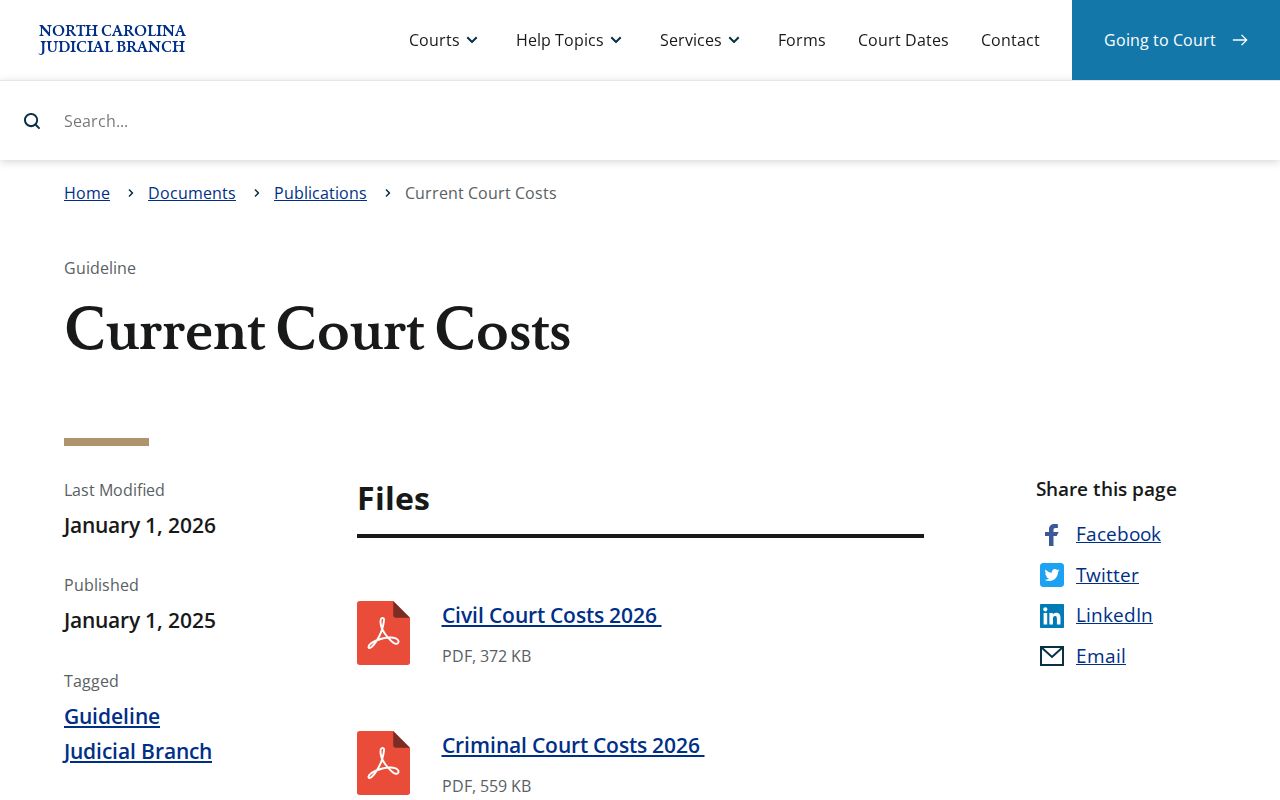
Fees shift over time, so confirm the current charges with the Randolph County Clerk when you actually place a copy or certification request.
| Randolph County record service | Current listed amount |
|---|---|
| First prepared page of each document | $2.00 |
| Each additional page or fraction | $0.25 |
| Certificate under seal | $3.00 |
| Exemplification | $10.00 |
| Criminal-record search | $25.00 |
Randolph Transcript and Audio Records
A Randolph County transcript, an audio copy, and a docket sheet are three separate requests. For transcripts, the rate is set by the court reporter or an approved transcriptionist. The local court reporter can be reached at 336-328-3155. If a recording exists for a nonconfidential case type, the clerk can provide a digital-audio copy. That process can involve form AOC-G-114. The court file itself stays with the Randolph County Clerk.
Ask for the precise Randolph County record you need, not a broad "court record." Someone after an order may need the Clerk file. Someone who needs the words of a proceeding needs a transcript. Someone who wants the sound of it goes through the clerk's audio process. Each route carries its own availability and charges. A public Case Summary cannot substitute for any of them.
- Certified copy
- A Randolph County copy authenticated by the Clerk for official use.
- Transcript
- A written record prepared through the court reporter or approved transcriptionist.
- Case Summary
- The Portal’s dated list of core Randolph County case events and data.
Access Rules for Court Records
Randolph County court records are open to public inspection unless a law says otherwise. Portal offers one public route, providing Case Summaries and whatever public documents are available there. Need the underlying court file? The Clerk is the office to use for the terminal, paper copies, or certification. Open access still has limits. Sealed, confidential, sensitive, juvenile, protective-order, and expunged material stays restricted.
The official N.C.G.S. §7A-109 source lays out the records, dockets, and indexes the clerk maintains. It also sets the rule for public inspection.
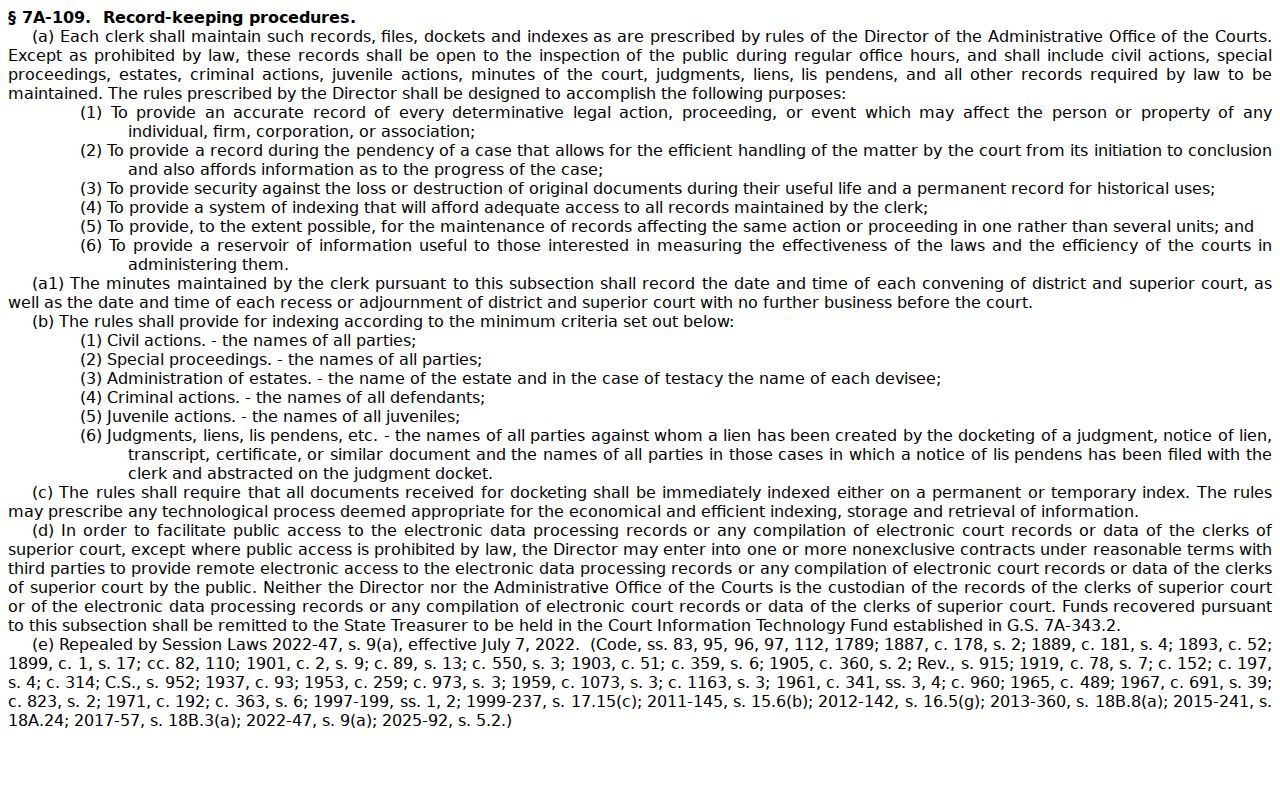
That statute anchors the Randolph County access rule while keeping statutory restrictions intact for particular records.
Key Rules:
N.C.G.S. §132-6.2 addresses certified and ordinary copies, lawful fees, and a requested explanation of denial.
N.C.G.S. §15A-151 makes expunction files confidential and limits disclosure.
N.C.G.S. §7B-3000 restricts public inspection of juvenile court records.
Randolph Court Records After Expunction
An expunged Randolph County record is not an ordinary court file. You cannot pull one on request. North Carolina calls the statutory process expunction, sometimes expungement. Whether a case qualifies turns on the governing statute and how it ended. Once a judge grants it, the old file stops being something the public Portal or the Clerk will hand over. The Judicial Branch instead runs a separate verification-certificate process where one is available.
A docket search that turns up nothing does not always mean expunction, though. The case may be sealed, juvenile, or tied to a restricted protective order. It could simply sit in the wrong county, carry a formatting error, live only on paper, or lag in indexing. For an access question, ask the Randolph County Clerk. That inquiry cannot override a legal restriction. The state expunction resource lays out the forms and the general process.
Note: A Randolph County Portal screen is a public information view only. The Clerk controls official copies and lawful access.
Randolph County court records stay county-specific. The Randolph County Clerk holds the original trial files. A Portal search and a file request do different jobs. Know which one you need before you start. The case number matters most. It routes your request to the correct record every time. Superior Court and District Court files both run through the same Randolph County clerk system. Some documents never go online. Those paper files stay part of the county's access path. For any record type, the clerk channel is the reliable road.